
Articles / Reflection
On presence in a world where every free second must be filled with something.
This morning began with someone very close to me telling me about a book he had recently read—and then burned. The book was Freedom from the Known. He told me that one of its ideas was the importance of being fully present in every moment. It also explored freedom from past experience and the ability to see what is happening without filters or prejudice.
To me, this sounded obvious and predictable, yet the subject clearly resonates with many people. As we know, the most obvious truths are often the hardest to put into practice.
When I hear the phrase “being fully immersed in the moment,” the first thing that comes to mind is modern teenagers watching a film while simultaneously scrolling through TikTok, having a conversation about a third subject, and consuming buckets of snacks. And that is only the minimum. I have two younger sisters, and this is something I often witness when I visit my family home.
But it is not only teenagers, nor is it only modern society. To some extent, all of us do the same thing. We listen to podcasts or watch television over dinner. We play music while working or exercising. We answer messages in the middle of a conversation with the person sitting directly across from us—and so much more.
I am sure every reader can easily find similar examples in their own life. I certainly have plenty of them. Of course, remaining in the here and now is not easy, especially when we are standing in a queue or trying to combine pleasure with usefulness.
Zero percent judgment. One hundred percent understanding.
I have a friend who needed some help a while ago, so she stayed with me for around six months. Before that, our conversations had been sporadic and fairly superficial.
While we were living together, I noticed something about her.
One day, we were on our way to a lecture about Medusa the Gorgon. Halfway there, she suddenly began searching through her pockets in horror. Eventually, she admitted that she had forgotten her headphones and had no idea how she was going to make it to the lecture hall.
And how would she walk back afterwards?
This made no sense to me. We were walking together, so obviously we had things to talk about. She was also in a new city—she had never lived in Lviv before. After the lecture, we could have discussed the lecture itself.
A few dozen metres later, however, she confessed that she liked talking to someone while listening to them with one ear and to music with the other. Or to a podcast.
The very idea of going for a walk seemed strange to her. She considered it a waste of time. Why walk for no particular reason when you could listen to something “useful” in the background?
Later, I noticed a similar habit in several other people. And I sometimes enjoy listening to music myself while riding the tram or walking to the swimming pool along a route I know very well.
It made me wonder why we are so eager to fill every free second—and what becomes available to us when we stop doing it.
Is it an unwillingness to focus on the present moment? A desire to rush through life as quickly as possible? Or a fear of being left alone with our own thoughts?
The modern world is a world of fast information. News, messages, market fluctuations, discounts, limited offers, and endless notifications are only a few taps away. At the same time, it is easy to convince ourselves that all the information we consume will become useful one day.
What harm could one more saved cake recipe possibly do?
The uncomfortable truth is that we will probably never return to it. The recipe will disappear among hundreds of other saved ideas, while the few minutes of our attention that we gave it will never come back.
True freedom does not mean completely rejecting the phone and adopting an ascetic lifestyle. Not at all.
As the Apostle Paul wrote,
“Everything is permissible for me, but not everything is beneficial… and I will not be mastered by anything.”
True freedom lies in having a choice.
Do I want to turn on music right now, or can I calmly live through this hour while listening to birdsong— or the sound of a hammer drill?
Am I playing another podcast because it genuinely matters to me and interests me? Or am I playing it because I am afraid of being alone with my thoughts?
Because unresolved problems are dripping into my mind, one drop at a time, and the thought that I might lose someone close to me feels unbearable?
The boundary, then, is not between silence and sound. It lies between choice and the inability to exist without additional stimulation.
Balance matters in everything, and this is no exception.
Returning to my own experience, I want to show how this works through a personal example.
Recently, I went to the seaside with someone very close to me. One evening, we went to watch the sunset.
Oh, it was beautiful.
The light, the colours, the sea, the sounds, the smells—everything was beautiful. It is difficult to imagine anything more beautiful than nature.
We arrived at the beach around an hour before sunset and left about an hour after the sun had completely disappeared beyond the horizon.
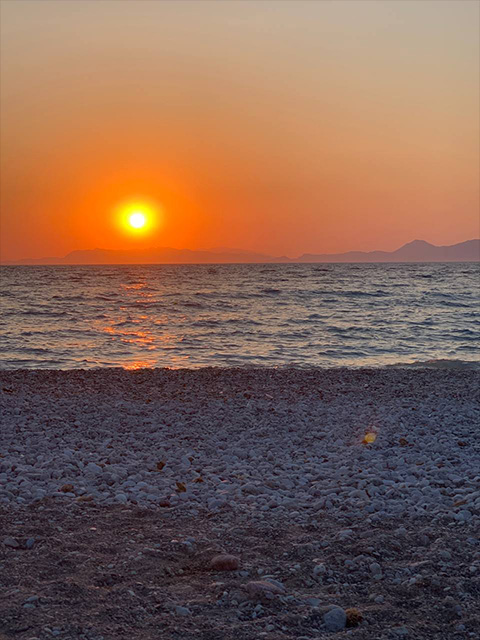
The only photograph I have serves more as a guide for my memory than as an attempt to preserve the moment itself. I did not compose the shot or adjust the camera. The photograph looks fairly ordinary. The horizon is probably crooked, and it is one of only two photographs from the entire trip.
I took it very quickly—almost instantly—because I did not want to miss a single moment of the setting sun.
I watched the sky changing in every direction and the clouds moving above us. It seemed to me that the sun was hiding between the mountains, although in reality it was setting behind them.
I watched the reflections on the water and the foam illuminated by the sunset as it broke against the shore. The orange light of the sun dissolved into the deep blue of the sky and the sea.
The moment was so beautiful that there are no words in this world that could fully describe it.
We lay there and watched that magnificent sunset in almost complete silence, even though we had a million and one unresolved questions and subjects to discuss.
But I was enjoying the moment. The presence. The silence. The sound of the water. The air. Everything that was happening around us.
Even then, I understood that this moment would remain with me for a long time.
Those two hours passed like a beautiful eternity on the one hand and like a single brief instant on the other.
Of course, this was not the first sunset I had ever seen. There had been many others that were no less beautiful, and some of them had also been by the sea.
But I had never surrendered so completely to the experience of watching a sunset.
There are, after all, entirely different ways of looking at one.
In the past, I went to watch sunsets because someone had told me they were beautiful. And if people say something is beautiful, then apparently you are supposed to go and see it.
You can also take a photograph afterwards, so you can show everyone: look, people, I went to see the sunset. I am a person too.
Or you can photograph yourself against the sunset.
There was a time when sunsets seemed incredibly boring to me, simply because I did not allow the moment to pass through me all the way to the marrow of my bones—to tingle beneath my skin.
Perhaps I was afraid. Perhaps I did not want to surrender to the moment completely and irreversibly. Or perhaps I simply could not disconnect from everyday life.
After all, everyone has unfinished business and current responsibilities.
That is why most of those sunsets are so difficult for me to remember. I cannot bring back the colour of the sun or the temperature of the air. They simply passed, like so many other days—in a hurry, in the desire to finish one episode as quickly as possible and move on to the next.
And yet how much more can a moment give us when we surrender to it completely?
“The more deeply we allow a moment into ourselves, the harder it becomes to let it go.”
While writing down my memories of that sunset, I began to cry.
I wrote and cried, unable to stop, because it had been so beautiful.
Moments we have fully lived sometimes return to us later almost physically. They are what we take with us and carry in our minds for as long as we remember.
And that is where the difficulty lies.
The more deeply we allow a moment into ourselves, the harder it becomes to let it go.
Beauty reminds us of impermanence. Intimacy makes us vulnerable. The present moment cannot be stopped or repeated, because every moment is unique.
We are no longer the people we were a second ago.
Everything has its price.
Presence does not mean constantly enjoying life. Life is not always filled with fluffy clouds and pink ponies.
Unpleasant things happen too.
Sometimes presence requires us to remain in moments that are painful, uncomfortable, or difficult. But that is another subject—one that deserves a conversation of its own.
This is not only about sunsets, of course. It applies to life as a whole: exercise, walks, food.
How much more can we receive from something as simple as a cherry when we are fully present with its taste, texture, temperature—even the stone inside it?
We begin to notice so many more details and so much more beauty in the world when we simply observe it in silence, rather than rushing to live and rushing to discover everything it is hiding.
Being present during a walk does more than help us notice birds on branches or tiny insects floating in the sunlight.
When we briefly stop consuming new information, everything we have already heard, read, and seen has an opportunity to settle inside us and form new connections.
Perhaps this is why so many ideas arrive while we are walking, showering, or doing something else that does not demand our full attention.
When the mind is constantly filled with other people’s words and images, there may simply be no space left for something of our own to appear.
Modern people often find it difficult to relax and do nothing simply for the sake of doing nothing.
Rest is frequently treated as another task intended to improve productivity. We no longer simply read or simply play games. We read in order to complete a certain number of books each year. We play in order to finish the next game.
A million similar examples could be found.
In our attempts to rest correctly, be present correctly, and recover correctly, we can turn even silence into one more item on a to-do list.
There is no need to give up photographs, content, or messaging while waiting in a queue. Not every tram ride has to become a spiritual practice.
But it matters that the possibility remains.
The question is whether we still have access to this kind of presence in our lives—whether we are still able to give ourselves fully to a moment without trying to escape from it.
Perhaps he burned the book because presence cannot be preserved as one more idea we have read about.
A book can only point us in a direction.
Everything else has to be done by us—in the next walk, the next conversation, the next cherry, or the next sunset.
Perhaps what matters is not how many experiences we manage to fit into a life, but how many of them we are truly present for.